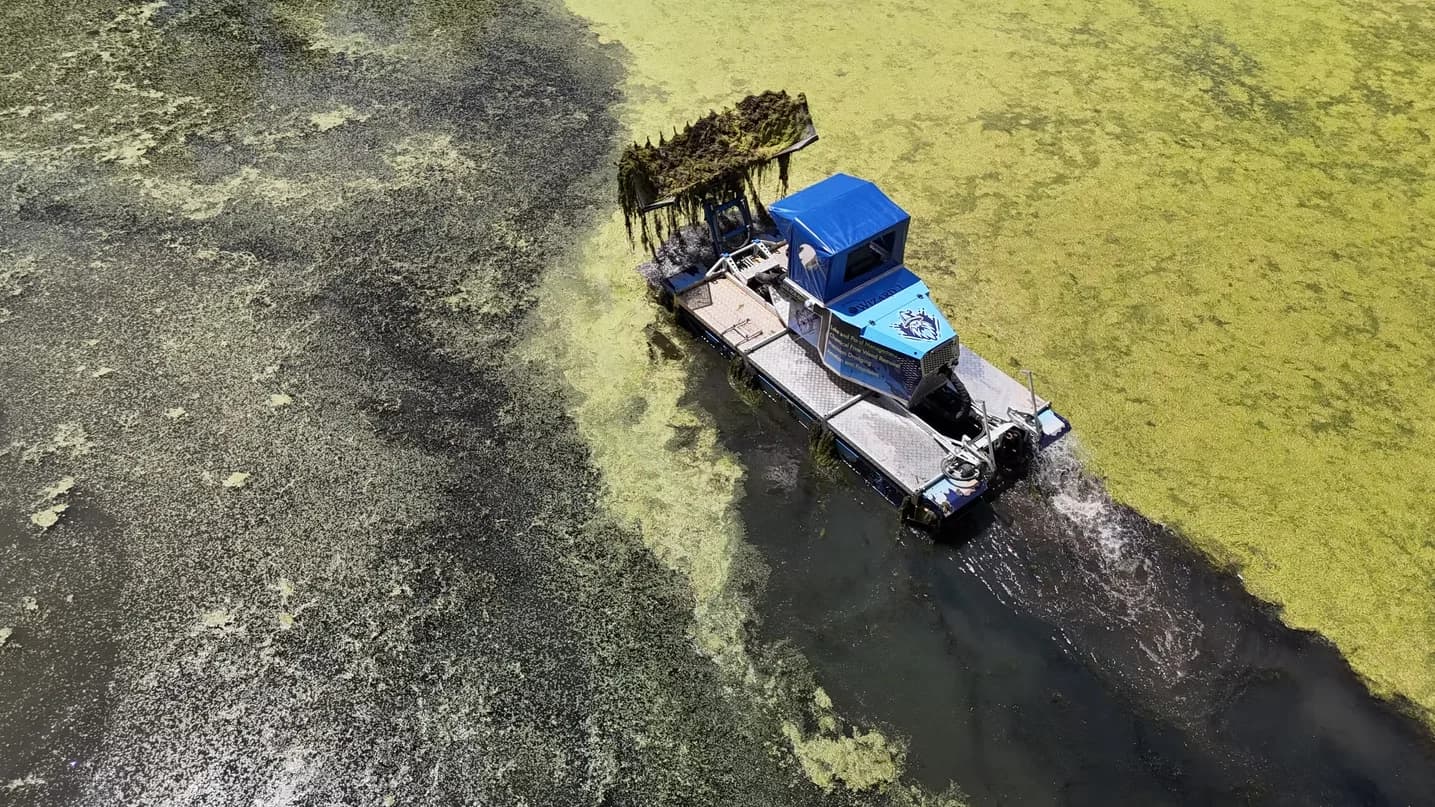
Most water bodies don’t fail overnight — they drift. A little more vegetation each month, a little more sediment at the inlet, a little more algae after storms. By the time it’s “a problem,” you’re paying for a big intervention instead of a few smaller, predictable visits.
The fix is a maintenance cadence: inspect, measure, remove what’s accumulating, and keep access open so bigger work is planned instead of reactive.
This guide is designed to be practical: a calendar you can execute, what to measure, and simple response playbooks so decisions are fast.
The clarity killers (what actually makes lakes look “bad”)
Most clarity issues are one (or a combination) of these:
- resuspension: fine sediment and organic muck stirred by wind/traffic,
- nutrients: fuel for algae and aggressive vegetation,
- biomass: mats and shoreline growth that trap debris and slow circulation,
- storm inputs: debris and inflow pulses that re-seed problems.
If you’re not sure which one is driving your site, start with a baseline from water quality testing.
Why maintenance beats emergency cleanups
Emergency work is expensive because it’s late. Maintenance is cheaper because it’s early.
The purpose of a plan isn’t to do “everything every month.” It’s to prevent the tipping point where clarity collapses and you’re forced into crisis work.
The three wins of a cadence
- Predictable costs: fewer surprise mobilizations.
- Higher effectiveness: you remove growth before it fragments and spreads.
- Better outcomes: you avoid the “reset then drift” cycle.
The seasonal calendar (a plan you can actually run)
Use this as a default template, then tailor it to your site’s use and constraints.
| Season | Primary goal | What to do |
|---|---|---|
| Spring | Reset access + visibility | Open lanes with harvesting; clear inlet corners; remove early growth before it becomes mats |
| Early summer | Baseline + tune | Run water quality testing; identify hotspots and a response threshold |
| Peak heat | Targeted response | Address mats and debris quickly; prioritize safety for algae risks (see toxic algae guide) |
| Fall | Prep next year | Shoreline cleanup; sediment hotspot scoping; access improvements; plan winter/spring scope |
If your shoreline is eroding or collapsing into the basin, integrate shoreline restoration so your maintenance plan isn’t fighting a bank that keeps failing.
What to measure (so the plan stays honest)
Good plans don’t rely on “feel.” They rely on repeatable indicators.
The minimum viable measurement set
- Visibility trend: consistent photos from the same 3–5 points (same time of day is even better).
- Vegetation coverage: note where growth returns first (those zones become the early-season focus).
- Inlet/corner buildup: track where debris pins and where fine sediment accumulates.
- Shallow shelf changes: shelves are weed factories; expanding shelves predict future workload.
When to upgrade measurement
If you have recurring algae events or need to justify scope, upgrade to a testing cadence:
- nutrient trend (not just one-time readings),
- oxygen considerations (especially in summer),
- algae risk screening when blooms appear.
Start here: water quality testing.
The decision tree: harvesting vs. dredging vs. “wait”
A lot of maintenance cost comes from doing the right action at the wrong time.
Use harvesting when
- mats are forming,
- shorelines are closing in,
- access lanes are disappearing,
- debris is trapped in vegetation.
Service overview: harvesting.
Use dredging when
- shallow shelves are expanding,
- turbidity spikes repeatedly after wind events,
- depth is being lost in inlets/coves,
- muck is the reason vegetation keeps accelerating.
Start planning here: sediment removal plans and lake dredging.
Wait (or do minimal work) when
- you don’t have enough data to pick the right lever,
- the site is stable and your trend lines are clean,
- you’re in a constrained window and a larger action would be wasted.
“Waiting” is still a plan if you’re monitoring and ready to respond quickly.
Response playbooks (so decisions are fast)
When a weed mat shows up
Goal: remove it before it fragments and drifts.
- cut and collect (don’t leave floaters),
- stage biomass so it doesn’t block access,
- clear the lane that keeps the shoreline visible for follow-up work.
When a storm dumps debris
Goal: restore flow-through and stop decomposition hotspots.
- clear inlets first so the basin can flush,
- remove pinned debris in corners,
- don’t let leaf/wood piles sit in the waterline (nutrient load builds fast).
When algae spikes
Goal: prioritize safety and measurement.
- don’t improvise around unknown blooms,
- keep people/pets out if there’s any risk,
- use the toxic algae guide for the first-response steps,
- validate with water quality testing before deciding next actions.
For general background on harmful algal blooms: https://oceanservice.noaa.gov/hazards/hab/
The checklist: your maintenance program in one page
- Define the “win condition” (clarity, access lanes, depth, shoreline stability).
- Pick 3–5 photo points and take baseline photos.
- Schedule a spring reset (usually harvesting-forward).
- Set a mid-season testing cadence if algae/turbidity are recurring.
- Decide response thresholds (what triggers a service call).
- Plan fall prep and sediment hotspot scoping.
Want a cadence built around your site? Start here: lake management.